IRGC SHADOW OVER SAHEL: HOW TEHRAN’S TERROR PIPELINE FUELS BOKO HARAM AND ISWAP RESURGENCE
ABUJA, Nigeria — Sophisticated drone strikes and a 46% surge in terror-related fatalities in Nigeria are pointing to a chilling new reality: the Islamic Republic of Iran is deepening its footprint in the West African Sahel. Investigative data and recent security reports suggest that Tehran’s “Axis of Resistance” now extends beyond the Middle East, leveraging illicit financial networks to embolden groups like Boko Haram and the Islamic State West Africa Province (ISWAP).
With the direct military confrontation between the U.S./Israel and Iran in February 2026, Tehran is desperate to create distractions for Western intelligence. By fueling instability in Nigeria—Africa’s largest economy—Iran forces a “two-front” intelligence war. As of March 2026, the Nigerian Government has issued high-level travel warnings for Nigerians in the Middle East, fearing that the escalation there will lead to “sleeper cell” activations within Nigerian borders.
The Drone Connection: A Shift in Tactics
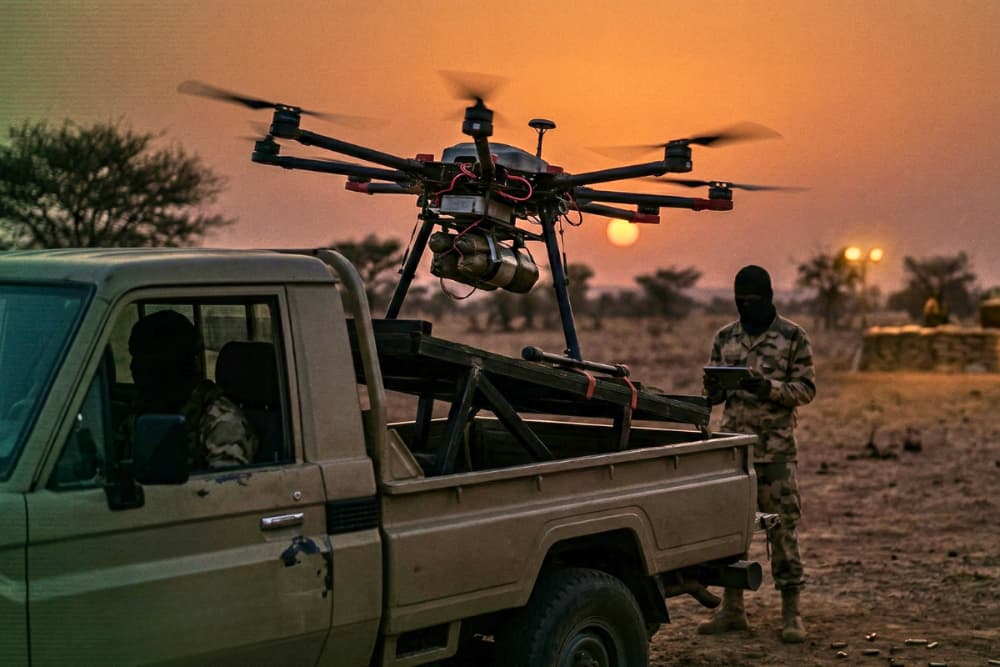
On March 18, 2026, the Nigerian Army foiled a massive assault in Mallam Fatori, Borno State, killing over 60 terrorists. Crucially, the military reported that the insurgents utilized advanced armed drones to breach defensive positions. Security analysts link this sudden jump in technical capability to the Islamic Revolutionary Guard Corps (IRGC), which has historically used Africa as a testing ground for asymmetric warfare.
Tactical Sophistication: Recent attacks show a shift from “hit-and-run” tactics to coordinated, multi-vector assaults.
The IRGC Blueprint: Reports from the Africa Defense Forum indicate the IRGC is embedding “advisory” cells within the Sahel to exploit the security vacuum left by declining Western influence.
Terror Financing: The “Shadow Banking” Web
The Financial Action Task Force (FATF) and the U.S. State Department have recently flagged intensified efforts by Tehran to move funds through “shadow banking” networks. These funds, derived from illicit oil shipments, are increasingly diverted to African proxies to bypass international sanctions.
Money Laundering Hubs: Iran-aligned operatives are reportedly using front companies in the Sahel and Gulf of Guinea to wash “terror-dollars.”
Ideological Nucleus: The Islamic Movement in Nigeria (IMN) remains a focal point for Iranian doctrinal influence, which security experts believe serves as a recruitment pipeline for more radicalized paramilitary wings.
Global Terrorism Index (GTI) Warning: The 2026 GTI highlights that while global terror deaths dropped, Nigeria saw a massive spike, fueled by these external “enablers.”
“Iran is placing its bets on the African continent, taking advantage of the political and security vacuum… turning entire regions into extensions of Tehran’s strategic project.” — Institute for National Security Studies (2025/2026 Analysis).
Regional Instability and the 2026 Outlook
With the direct military confrontation between the U.S./Israel and Iran in February 2026, Tehran is desperate to create distractions for Western intelligence. By fueling instability in Nigeria—Africa’s largest economy—Iran forces a “two-front” intelligence war.
As of March 2026, the Nigerian Government has issued high-level travel warnings for Nigerians in the Middle East, fearing that the escalation there will lead to “sleeper cell” activations within Nigerian borders.