
Faith Under Fire: Modernity Forces High-Stakes Doctrinal Overhauls
LAGOS, Nigeria — A quiet revolution is dismantling the “untouchable” pillars of global Christendom and religious orthodoxy. From the historic halls of the Vatican to the sprawling auditoriums of Lagos’s Pentecostal giants, and into the local Kingdom Halls of Jehovah’s Witnesses, religious institutions are currently navigating a high-stakes pivot between ancient scriptural fidelity and the relentless pressure of 21st-century social and medical realities.
By verifying scriptures independently and maintaining social networks outside of church walls, individuals can protect their mental and financial health as the religious world moves toward a permanent theological divorce between the modernizing Global North and the traditionalist Global South.
What was once considered heresy is fast becoming “contextual clarification,” as an investigation into recent doctrinal shifts reveals a global religious landscape in the throes of a profound identity crisis, with denominations struggling to remain relevant to a “next-gen” seeker who values authenticity over rigid traditions.
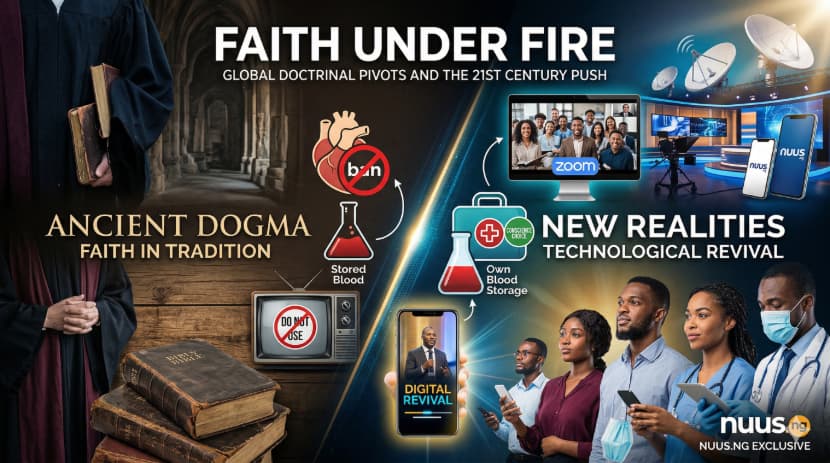
In a move sending shockwaves through both religious and medical circles, the Governing Body of Jehovah’s Witnesses officially announced a landmark “clarification” to its doctrine on blood. For the first time in the organization’s history, members are now permitted to decide, as a matter of personal conscience, whether to store and reuse their own blood for medical procedures.
The announcement, delivered by Governing Body member Gerrit Lösch via a video update on March 20, 2026, marks one of the most significant shifts in the group’s 150-year history. While the fundamental ban on receiving blood from third-party donors remains strictly in place, the new directive effectively greenlights autologous blood transfusions—a practice previously viewed as a violation of the biblical mandate to “abstain from blood.”
For decades, the Watchtower Society interpreted biblical passages such as Acts 15:29 and Leviticus 17:13 to mean that once blood leaves the body, it must be “poured out on the ground,” strictly prohibiting preoperative autologous donation (PAD). The new policy shifts this responsibility to the individual, allowing members to authorize the withdrawal and reinfusion of their own blood for elective surgeries.
This “New Light” offers a massive relief for surgical teams in Nigeria, where Jehovah’s Witnesses represent a significant demographic, allowing for advanced blood-management strategies like cell salvage. However, since the ban on allogeneic (donated) blood remains, experts warn this provides little help in emergency trauma cases. While some welcome the flexibility, critics point to the thousands who died over decades adhering to the stricter ban, asking why conscience was not a factor thirty years ago.
Parallel to this medical shift, a historic departure from rigid doctrine is unfolding within one of Africa’s largest holiness movements. Pastor William Folorunsho Kumuyi is leading a radical “technological revival” within the Deeper Christian Life Ministry (DCLM). The church, which for decades infamously labeled television as the “devil’s box,” has now fully pivoted. During the recent 2026 Leadership Strategic Congress, the octogenarian General Superintendent doubled down on his mandate for reform, urging pastors to abandon “old activities” in favor of “new productivity.”
This shift represents a fundamental re-engineering of the church’s evangelical DNA, moving from a decades-long discouraging of media ownership to a strategy where tools like Zoom, social media, and satellite TV are seized and repurposed for the Gospel.
Building on these events, the 2026 reform at the Gbagada Headquarters suggests an aggressive phase where the “old way is over.” Kumuyi’s “Covenant Service” address served as a warning to conservative leaders: “Don’t come into 2026 with the old ability and old activities if you want new productivity.” This “New Covenant” approach aims to modernize the ministry’s outreach through the Global Crusade with Kumuyi (GCK) without compromising its core message of holiness. Yet, the “reformed” Deeper Life faces internal friction as veterans grapple with the rapid dismantling of traditions.
These local shifts are mirrored by a broader fracture occurring within the Anglican Communion. In a move that has effectively severed ties between the Global North and South, the Church of Nigeria (Anglican Communion) officially broke from the Church of England in late 2025 following the appointment of Sarah Mullally as the first female Archbishop of Canterbury.
Nigerian Primate Henry Ndukuba labeled the election a rejection of biblical authority. Simultaneously, the Vatican is walking a tightrope under Pope Francis; the implementation of Fiducia Supplicans has allowed priests to offer “spontaneous blessings” to couples in irregular situations, including same-sex partners—a move largely rejected by Catholic bishops across Africa.
In Nigeria, this broader shift is less about social liberalization and more about a transition to “Corporate Pentecostalism” and “material spirituality,” where faith intertwines with entrepreneurship. However, research indicates that these “franchise-faith” models are facing a backlash.
Next-gen believers in 2026 are increasingly disillusioned with “plastic pulpits,” leading to the birth of the Urban Monastic Movement, which prioritizes social justice and transparency over massive cathedral projects.
As these global and local denominations undergo these significant doctrinal shifts, many congregants find themselves vulnerable to spiritual disorientation, financial loss, or deep emotional pain. To protect against future regrets, members must recognize red flags such as financial exploitation under “new revelation,” where sudden doctrinal shifts demand “emergency” seeds to meet administrative deficits. Isolation and the “Silent Pivot”—where major rules are scrapped overnight without an apology for past enforcement—often lead to “betrayal trauma” for those who lived by stricter codes for decades.
To navigate these changing tides, members are encouraged to maintain a “Berean” mindset. This involves demanding transparency in church changes, auditing their giving to ensure it funds sustainable ministry rather than lifestyle upgrades, and prioritizing “Primary Truths”—the core tenets of the Gospel—over non-essentials like technology bans or dress codes.
By verifying scriptures independently and maintaining social networks outside of church walls, individuals can protect their mental and financial health as the religious world moves toward a permanent theological divorce between the modernizing Global North and the traditionalist Global South.