
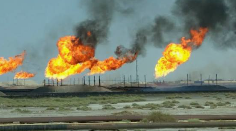
Gas Flaring: Nigeria loses $5.5bn as methane waste hits $30m daily
By Folarin Kehinde
For decades, Nigeria has remained one of Africa’s largest producers of crude oil and natural gas. Yet, across oilfields in the Niger Delta, billions of cubic feet of valuable natural gas are either burned through routine flaring or lost through leaks and venting, depriving the country of electricity, cooking gas, industrial growth, government revenue and cleaner air.
The economic consequences are enormous.
Analysis of data from the National Oil Spill Detection and Response Agency (NOSDRA) Gas Flare Tracker shows that Nigeria lost an estimated $5.5 billion (about ₦8.7 trillion) worth of natural gas through routine gas flaring between 2021 and 2025.
The estimate represents only the direct market value of gas burned, based on satellite flare detection and average gas prices.
However, experts say the actual cost is far higher.
Mahmoud Ibrahim Mahmoud, a postdoctoral researcher and environmental scientist with NOSDRA, told Vanguard that Nigeria’s wider economic losses from methane waste and associated gas flaring—including lost electricity generation, liquefied petroleum gas (LPG), industrial feedstock, government revenue, environmental damage and unrealised carbon-market opportunities—could range between $18 million and $28 million daily.
Under favourable carbon-market conditions, Mahmoud estimated that the country’s unrealised opportunity could exceed $30 million per day, translating to about $7 billion to $12 billion annually.
“The true national loss is substantially larger than the commodity value shown on the Gas Flare Tracker because methane that is flared or vented could otherwise generate electricity, supply households with LPG, support fertilizer and petrochemical industries, earn export revenue and generate taxes and royalties,” he said.
A resource burned instead of used
Nigeria has one of Africa’s largest proven natural gas reserves, estimated at more than 215 trillion cubic feet, yet gas flaring remains a persistent feature of oil production.
According to NOSDRA’s 2025 Gas Flare Report, operators flared about 323 billion standard cubic feet (SCF) of gas during the year.
The agency estimated that the wasted gas was worth about $1.1 billion (₦1.49 trillion), generated approximately 17.2 million tonnes of carbon dioxide emissions, and could have produced more than 32,300 gigawatt-hours (GWh) of electricity—enough to significantly improve Nigeria’s power supply.
Similarly, data from the Nigerian Upstream Petroleum Regulatory Commission (NUPRC) showed that nearly 204 billion standard cubic feet of gas was flared in 2025 despite overall gas utilisation exceeding 92 per cent.
The figures highlight one of Nigeria’s biggest energy contradictions: abundant gas reserves existing alongside persistent electricity shortages and rising cooking gas prices.
Counting the real economic loss
Mahmoud argued that valuing gas only by its market price significantly understates the impact of methane waste.
He noted that captured methane could supply gas-fired power plants, reduce dependence on diesel generators, expand domestic LPG production, provide feedstock for fertilizer and petrochemical industries, generate export earnings through LNG, increase government tax and royalty collections, and earn carbon credits under international markets.
“As a conservative estimate, Nigeria is likely foregoing between $18 million and $28 million every day.
“When carbon markets are considered, the unrealised opportunity could exceed $30 million daily,” he said.
He added that the losses affect all segments of society.
“The Federal Government loses taxes, royalties, export earnings and foreign exchange. Oil-producing states lose industrial development and employment opportunities.
“Host communities bear the environmental degradation, polluted air, damaged farmlands, declining fisheries and health impacts.
“Ordinary Nigerians pay through higher electricity costs, expensive cooking gas, poor energy security and slower economic growth.
“In practical terms, everyone pays,” Mahmoud said.
Communities living beneath the flames
For residents of oil-producing communities, methane waste is not merely an environmental statistic but a daily reality affecting their health, livelihoods and future.
Chairman of the Council of Chiefs of Lasukugbene Community in Southern Ijaw Local Government Area of Bayelsa State, Chief Zion D. Kientei, said decades of gas flaring and pipeline leaks had fundamentally altered life in the Niger Delta.
He said communities that once depended on thriving rivers, fertile farmlands and abundant fisheries now struggle with polluted air, declining crop yields, disappearing fish species and worsening health conditions.
“Our flare stack is less than 200 metres from the community. It has altered our ecosystem. The fish species we grew up seeing have disappeared. Crop yields have reduced drastically, and children born today will never know the environment we once enjoyed,” he said.
Kientei said the environmental damage had resulted in rising respiratory and cardiovascular illnesses among residents exposed to years of pollution.
He also expressed concern over declining life expectancy in the Niger Delta, citing environmental findings in Bayelsa State.
“By virtue of the recent environmental report from Bayelsa State, we discovered that the life expectancy of the average Bayelsan is now less than 45 years.
“If urgent action is not taken to tackle gas flaring, methane emissions and environmental pollution, the lifespan of our people will continue to decline. It is terrible,” he said.
He said the crisis had also triggered migration from oil-producing communities, while farmers and fishermen continued to lose their traditional livelihoods.
Beyond health impacts, Kientei argued that host communities had received little benefit from decades of oil production despite bearing the environmental burden.
“If there is one benefit communities have received from oil and gas activities, it is communal conflict. Economically, we have gained almost nothing that can compensate for what we have lost,” he said.
He blamed weak enforcement of environmental regulations, alleging that regulators had failed to effectively hold oil companies accountable.
“The regulators are supposed to regulate the oil companies, but too often it appears the oil companies regulate the regulators,” he said.
Kientei called for stronger collaboration among government, regulators and operators to accelerate gas capture projects, modernise infrastructure and ensure wasted gas is converted into electricity, cleaner cooking fuel and other productive uses.
Environmental cost beyond economics
For environmental campaigners, methane emissions represent both a climate emergency and a public health crisis.
Executive Director of the Renevlyn Development Initiative (RDI), Philip Jakpor, said methane emissions rarely occur alone but are often accompanied by hazardous pollutants such as benzene and hydrogen sulphide.
“When methane is released alongside these pollutants, communities are exposed to serious health risks.
“Air pollution, contaminated soil and polluted water ultimately affect agriculture, livelihoods and public health,” he said.
Jakpor said although Nigeria had introduced regulations such as the Venting and Methane Emissions (Prevention of Waste and Pollution) Regulations 2023 and provisions under the Petroleum Industry Act, enforcement remained inconsistent.
He noted that while government continued to make climate commitments, available data showed gas flaring increased in 2025.
He called for stronger satellite monitoring, independent emissions tracking and transparent reporting to improve accountability.
Industry sees missed opportunities
Operators in Nigeria’s energy sector also believe methane waste represents a major economic opportunity.
Managing Director of Excella-U Energy Limited, Engr. Oseagah Solomon, described Nigeria as a country “not short of gas but short of the will to capture it.”
“We are burning away resources that should be lighting homes, powering businesses and earning foreign exchange,” he said.
He noted that gas currently flared annually could generate significant electricity while supporting cheaper LPG, fertilizer production and petrochemical industries.
According to him, financing challenges, inadequate infrastructure, weak implementation of gas commercialisation programmes and policy uncertainty remain major obstacles.
Independent petroleum marketer, Chief Ajiboye Adebowale Moses, also argued that every unit of methane wasted represented lost economic value.
“If captured instead of burned, methane can support electricity generation, cooking gas, fertilizer production and industrial development,” he said.
Can technology close the gap?
Experts agree that better measurement is essential.
Mahmoud said satellite technology alone cannot fully quantify methane emissions, advocating a combination of satellite observations, drones, airborne sensors and ground-based monitoring systems.
Such integrated monitoring, he said, would improve transparency, help regulators identify leaks, verify company reports and strengthen enforcement.
He also recommended expanding digital platforms such as the Nigerian Gas Flare Tracker alongside the proposed Nigerian Methane Emissions Tracker.
Turning waste into wealth
Across interviews with regulators, industry operators, environmental advocates, host communities and Nigerians, one message remains clear: Nigeria’s methane challenge is no longer just an environmental issue but an energy, economic and governance challenge.
The country has the resources, regulations and technological capacity to reduce gas waste.
What remains uncertain is whether policy implementation, investment and enforcement will move quickly enough to transform billions of dollars currently disappearing into flames into electricity, affordable cooking gas, industrial growth and sustainable livelihoods.
Until then, every flare stack burning across the Niger Delta remains a visible reminder of an opportunity Nigeria continues to lose.
The post Gas Flaring: Nigeria loses $5.5bn as methane waste hits $30m daily appeared first on Vanguard News.