
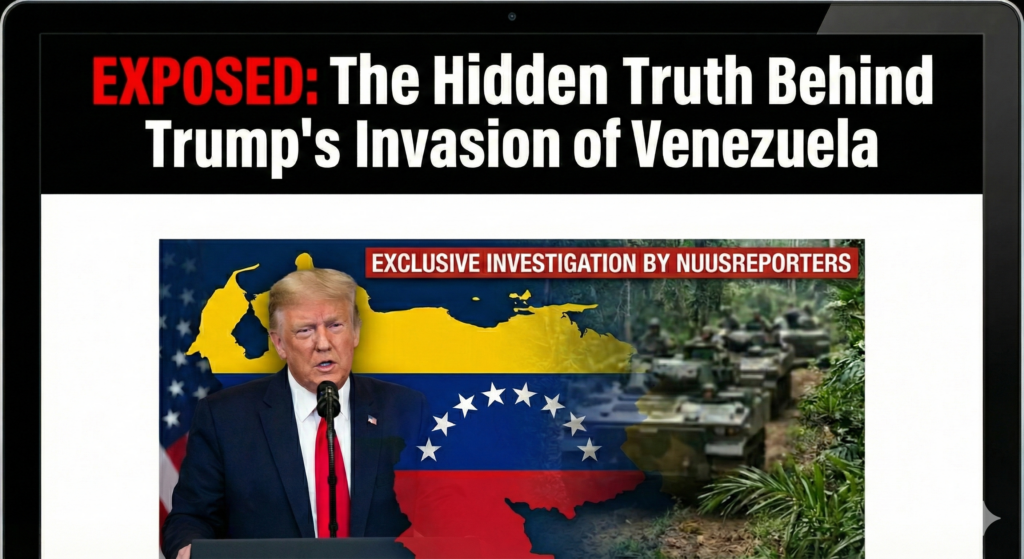
“EXPOSED: The Hidden Truth Behind Trump invasion of Venezuela
As American boots settle into the dust of Venezuela this January, a seductive narrative has taken hold across alternative media and encrypted channels. The theory is elegant in its simplicity: The United States didn’t invade Venezuela to restore democracy or alleviate a humanitarian crisis. America invaded to save the US Dollar from extinction.
This creates the theory of “Petrodollar Warfare”—the idea that the American empire rests solely on the 1974 agreement requiring oil to be sold in dollars, and that any nation defying this “rule” invites immediate regime change.
It is a compelling story that connects the dots between Saddam Hussein, Muammar Gaddafi, and now the Venezuelan regime. But as an investigative hypothesis, it is dangerously incomplete. While the defense of the dollar is a factor, the evidence suggests a much cruder reality. The world is likely not witnessing a desperate financial salvage operation, but rather a brazen, old-fashioned resource grab aimed at checking Chinese expansion.
The Ghost of 1974
To understand the current chaos, one must acknowledge where the “Petrodollar” skeptics are right. It is an established historical fact that in 1974, Secretary of State Henry Kissinger and Treasury Secretary William Simon struck a deal with the House of Saud: The US would provide military protection, and in exchange, the Saudis would price oil exclusively in dollars and recycle those petrodollars into US Treasuries.
This created a synthetic demand for the dollar that has outlasted the gold standard. However, the idea that the US economy is so fragile that Venezuelan oil sales—even with their massive 303 billion barrels of reserves—could collapse the financial system is economic hyperbole.
The US Dollar is anchored by a $26 trillion Treasury market and the fact that 88% of global foreign exchange involves the greenback. Venezuela’s economy is a rounding error compared to the US or the EU. The dollar is not a house of cards waiting for a stiff breeze from Caracas to knock it over.
The Bloody Precedent: Iraq and Libya
However, the “Petrodollar” theorists have history on their side regarding intent, if not economic reality.
Iraq (2000): Saddam Hussein switched his oil sales to Euros in November 2000. By March 2003, the US had invaded. While WMDs were the pretext, the timeline is undeniable.
Libya (2011): The “Gold Dinar” theory was once dismissed as conspiracy until the release of Hillary Clinton’s emails. A leaked memo from Sidney Blumenthal dated April 2, 2011, explicitly stated that Gaddafi’s hoard of 143 tons of gold was intended to create a pan-African currency to rival the franc and dollar. The email cited this financial independence as a primary driver for French and Western intervention.
The pattern is clear: Challenge the dollar, and the Tomahawks follow. But is that what is happening in 2026?
The China Factor and the “Liquidity Trap”
Venezuela has indeed been selling oil in Yuan, Rubles, and crypto to bypass sanctions. They have sought entry into BRICS to accelerate “de-dollarization.” But there is a flaw in the logic that this alone triggered the invasion.
While mechanisms like China’s CIPS and the mBridge project are real threats to SWIFT, the Chinese Yuan accounts for barely 5% of global payments. China has strict capital controls; it cannot yet offer the deep, liquid markets necessary to absorb global savings. The Dollar isn’t being replaced overnight because there is currently nowhere else for that much money to go.
The Real Motive: “Tyrannical Expropriation”
If the dollar isn’t on the immediate brink of collapse, why invade? The answer likely lies in the rhetoric coming out of Washington.
Listen closely to the justification provided by figures like Stephen Miller. The narrative has shifted from “freedom” to “entitlement.” Miller’s argument—that American ingenuity created the oil industry and that nationalization is “tyrannical expropriation”—is a mask slipping.
This is not about currency; it is about physical control.
Venezuela sits on the largest proven oil reserves on the planet. For the last decade, Russia and China have been slowly acquiring stakes in this energy via loans and development deals. In a world of Great Power Competition, the US cannot tolerate Beijing controlling the tap of 20% of the world’s oil supply in America’s backyard.
The Verdict
The “Petrodollar Warfare” theory serves as a convenient smokescreen. It paints the US as a desperate, failing giant lashing out to save its currency.
The reality is likely more calculating and cynical. The US isn’t fighting to keep the invoice in dollars; it is fighting to own the oil itself. The invasion of Venezuela is less about the abstract mechanics of the Federal Reserve and more about a return to 19th-century imperialism: denying strategic resources to a rival superpower.
America didn’t go to Caracas to save the bank. America went to take the assets.