
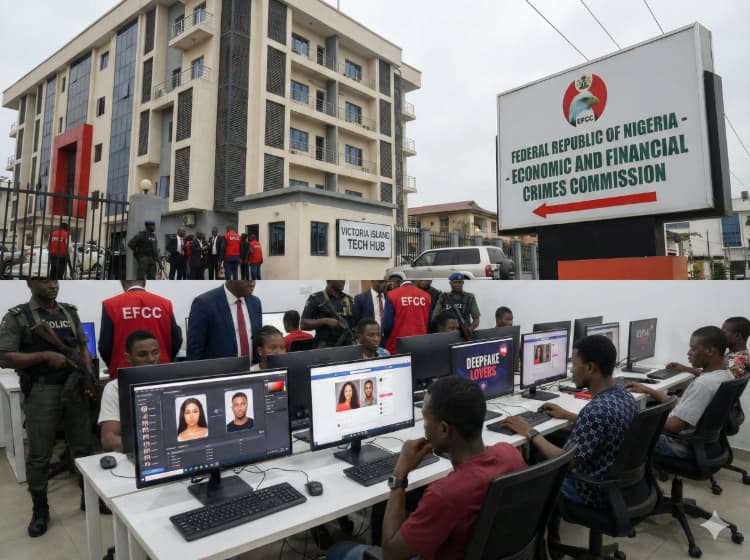
Deepfake Lovers: EFCC Raids Victoria Island ‘Scam Compound’ as Romance Fraud Goes Corporate using AI
LAGOS — The traditional image of the lone Nigerian “Yahoo Boy” typing in a dark room is dead. It has been replaced by a seven-storey corporate hub in the heart of Victoria Island, where hundreds of cybercriminals now clock in daily to use Artificial Intelligence (AI) to break hearts and drain bank accounts.
In what is now being described as the largest cybercrime bust in Nigeria’s history, the Economic and Financial Crimes Commission (EFCC) has dismantled an industrialized cryptocurrency and romance scam syndicate operating out of the “Big Leaf Building” on Oyin Jolayemi Street.
A staggering 792 suspects were arrested, including 148 Chinese nationals, 40 Filipinos, and over 500 Nigerians.
The “Deepfake” Evolution
For years, the standard advice to avoid a romance scam was simple: Insist on a video call. In 2026, that advice is no longer enough.
EFCC Chairman Ola Olukoyede revealed that this syndicate has evolved past stolen photographs. The arrested operatives were using advanced Deepfake AI technology and real-time voice cloning software to conduct live video calls with their victims across Europe, Mexico, and the United States.
“When the victim asked for a video call to prove the romance was real, the scammers complied,” Olukoyede explained in a briefing on Tuesday. “Using AI face-swapping software, a Nigerian operative would appear on screen as an attractive Asian or European partner. They aren’t just typing anymore; they are looking into your eyes and lying.”
Inside the ‘Scam Factory’
The raid exposed a disturbing shift in Nigerian cybercrime: the rise of the “Scam Compound”—a model previously seen in Southeast Asia but now imported to Lagos.
- The Structure: The syndicate operated like a modern tech company. The foreign nationals (Chinese and Filipinos) acted as the upper management and technical trainers, while the Nigerian youths served as the frontline emotional manipulators.
- The Playbook: Operatives were assigned WhatsApp and Telegram accounts linked to foreign numbers. Armed with psychological “training manuals,” they engaged victims in romantic conversations for months, effectively “fattening” them up emotionally.
- The Hook: Once the victim was in love, the scammers introduced them to a fake online investment platform called https://www.google.com/search?q=Yooto.com, convincing them to transfer their life savings into cryptocurrency under the guise of building a “future together.”
The AI Advantage
Cybersecurity experts note that 2026 has ushered in a dangerous new era for digital fraud. Generative AI allows these syndicates to automate conversations across multiple languages without grammatical errors, making the personas virtually indistinguishable from real people.
Tolu Akinwumi, a Lagos-based digital forensics expert, told nuus.ng that the Victoria Island hub represents the “corporatization of fraud.” “This was not a group of boys with laptops; this was a multimillion-dollar transnational enterprise,” Akinwumi said. “They had KPIs, target goals, and HR departments. AI gave them the scale to scam thousands simultaneously.”
Justice and Recovery
The EFCC operation recovered hundreds of high-end computers, luxury vehicles, and compromised mobile devices. The agency is currently working with international partners, including the FBI and Interpol, to trace the laundered funds—estimated in the tens of millions of dollars—back to the victims.
As Valentine’s Day approaches, the EFCC has issued a stark warning to online daters: If the person you met online pivots the conversation to crypto investments, disconnect immediately. In 2026, love is blind, but AI is watching.