
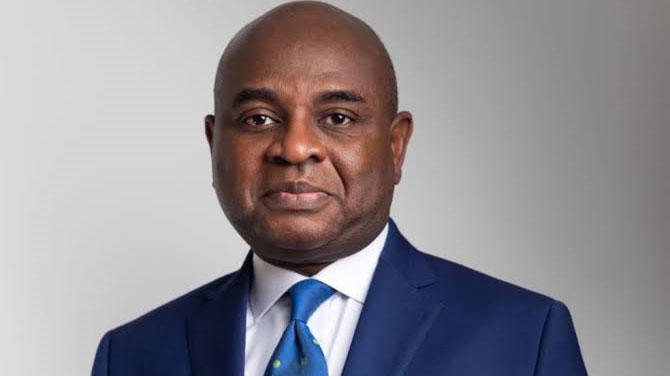
Correcting Africa’s map won’t bring prosperity – Moghalu
ABUJA— Former Deputy Governor of the Central Bank of Nigeria, Kingsley Moghalu, has welcomed a United Nations resolution encouraging the use of world maps that more accurately represent Africa’s size, but cautioned that a corrected map alone cannot drive the continent’s economic transformation.
Moghalu, who disclosed this in a post on his X platform on Sunday, said the UN General Assembly had voted 164-1 in support of the “Correct the Map” resolution, led by Togo on behalf of the African Group and backed by the African Union.
According to him, the resolution encourages schools, governments, international organisations and technology platforms to adopt equal-area map projections, such as Equal Earth, instead of the centuries-old Mercator projection.
He explained that the Mercator projection, developed in the 16th century primarily for navigation, distorts the relative size of landmasses by enlarging areas closer to the poles and shrinking those around the equator.
Moghalu noted that Africa is about 14 times larger than Greenland, although the two landmasses appear almost comparable in size on the conventional Mercator map.
He stressed, however, that the UN resolution was not legally binding, did not prohibit the use of Mercator for navigation and would not alter national borders.
“The resolution is not binding. It does not ban Mercator for navigation. It does not redraw a border. It asks the world to stop teaching a distortion as geography,” he said.
Moghalu argued that the significance of the resolution went beyond cartography, saying maps could influence how people perceive the importance and position of different parts of the world.
“Maps are never only maps. They are instruments of worldview. They tell children who is large and who is small, who is central and who is peripheral,” he said.
He said correcting the distorted visual representation of Africa was important for the continent’s dignity and how it was perceived globally, but warned that greater visual representation would not automatically translate into economic development.
“A map can change how the world sees Africa. It cannot change how African states organise themselves,” Moghalu said.
Drawing from his book, Emerging Africa, he said Africa was “emerging, not rising”, arguing that visibility and changing narratives were different from genuine transformation.
According to him, sustainable development requires productivity, skills, good governance, strategic planning and a coherent sense of national purpose.
“Development is first a state of the mind. Without that inner architecture — values, strategy, organisation — we keep mistaking symbols for substance,” he said.
Moghalu also pointed to the experience of Asian economies, including China, South Korea, Singapore, Taiwan and Vietnam, arguing that their economic transformation was driven by investments in education, industrial capacity, state institutions and long-term national strategies rather than symbolic changes in perception.
“The map followed the factories, not the other way around,” he said.
He urged Africans to use the corrected representation of the continent as an opportunity to rethink what could be achieved with its vast land and resources.
“Teach the true size of Africa. Let children see that this continent can contain the United States, China, India, Japan, Mexico and much of Europe and still have land to spare,” he said.
He, however, challenged African leaders and citizens to go beyond pride in the continent’s size and focus on building productive economies.
“A fairer map is a beginning of perception. It is not the beginning of prosperity. The world does not owe Africa a projection. Africa owes itself a plan,” Moghalu said.
The post Correcting Africa’s map won’t bring prosperity – Moghalu appeared first on Vanguard News.