
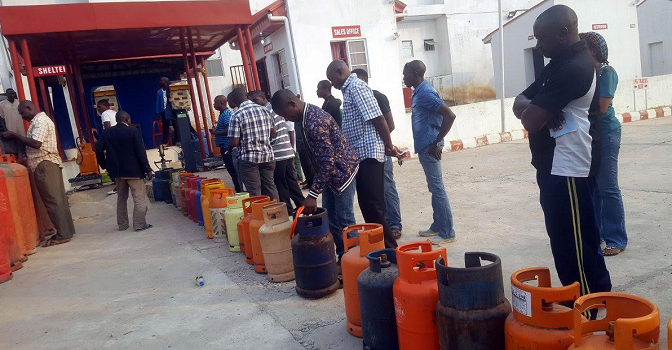
Cooking gas: FCT residents still groan over high cost
Many residents of the Federal Capital Territory (FCT) are still groaning over the high cost of Liquefied Petroleum Gas (LPG), known as cooking gas, despite the recent decline in prices.
Residents, who spoke with the News Agency of Nigeria on Sunday in Abuja, said although prices had dropped from levels recorded earlier in the year, cooking gas remained unaffordable for many households.
NAN reports that cooking gas is currently sold at between N1,250 per kg and N1,650 per kg across the FCT, depending on location and the point of purchase
Major gas outlets and depots generally offered more competitive prices; roadside retail vendors in some areas sell at higher rates.
At the current prices, a 5kg cylinder costs between N6,250 and N8,250, while a 12.5kg cylinder sells for between N15,625 and N20,625.
NAN reports that prices had stabilised significantly over the past two months following a sharp rise earlier in the year when the commodity sold for nearly N2,000 per kilogramme in some parts of the FCT.
In June, cooking gas sold for between N1,498 and N1,650 per kilogramme, while some roadside vendors sold the product for as high as N1,850 per kilogramme.
However, residents said more needed to be done by the government and industry stakeholders to drive prices further down and make cooking gas more affordable to low and middle-income households.
Mr Innocent Emmaunel, a resident of Gudu and public servant, said the reduction was welcome but had yet to make a significant difference to household budgets.
“Although the price has come down, it is still expensive for ordinary families. Many people now buy smaller quantities because they cannot afford to fill their cylinders at once,” he said.
Mrs Elizabeth Tanko, a resident of Lugbe, said the price reduction would only be meaningful if it was sustained.
“We have seen prices come down before, only for them to rise again. What consumers need is a stable price so that we can plan our household expenses,” she said.
Mrs Zainab Isiaka, a resident of Kubwa and businesswoman, said the cost of cooking gas was putting pressure on household finances
“We are happy that the price is no longer around N2,000 per kg like it was some months ago, but even at N1,300 it is still a lot for families that are struggling with food and transportation costs.
“The government needs to do more to bring the price down to a level that ordinary Nigerians can afford,” she said.
Similarly, Mr Eteka Eyo, a resident of Wuye and civil servant, urged the government to sustain efforts to increase domestic production and improve distribution.
“If there is enough gas in the country, there should be no reason for the price to remain this high. We need policies that will make the product available and affordable,” he said.
An energy expert, Mr Chris Mordi, attributed the recent moderation in LPG prices largely to improved product availability and easing supply constraints across the downstream market.
“The recent moderation in LPG prices is primarily driven by an improvement in product availability across the downstream market, which has eased supply constraints and reduced pressure on depot prices.
“We are seeing a better alignment between supply and demand, while reductions in depot prices are gradually filtering through the distribution chain.
“Increased competition among LPG suppliers and marketers is also contributing to the downward adjustment in retail prices.”
Mordi said the extent to which consumers would benefit would continue to depend on logistics and transportation costs, distribution margins, exchange rate movements and the sustainability of domestic LPG supply.
“If the current improvement in supply is sustained and there are no major disruptions in the upstream or import-supply chain, the market could experience further price moderation in the near term.
“The key issue is to ensure that increased supply translates into stable and affordable prices for end-users,” he said.
NAN recalls that in response to rising cooking gas prices, the Federal Government on June 22 directed a clampdown on marketers engaged in the hoarding or diversion of LPG.
The Minister of State for Petroleum Resources (Gas), Mr Ekperikpe Ekpo, issued the directive during an emergency stakeholders’ engagement on rising LPG prices, following deliberations with regulators, producers, marketers and other industry players.
Ekpo directed the Nigerian Midstream and Downstream Petroleum Regulatory Authority (NMDPRA), other regulators and security agencies to intensify market surveillance, investigate product hoarding and diversion, and sanction operators found manipulating the market.
He said that the Federal Government remained committed to increasing domestic supply, reducing reliance on imports and ensuring that locally produced LPG was prioritised for domestic consumption.
The minister also said the government was exploring a local LPG blending initiative involving the Nigeria LNG Ltd., local producers and the Port Harcourt plant operator to reduce logistics costs, improve supply reliability and support more stable prices.
At the meeting, the NMDPRA identified global supply disruptions and price volatility arising from the Israel-Iran conflict as major factors that contributed to upward pressure on LPG prices.
The authority also attributed the price situation to inadequate domestication of local LPG production, low import volumes, non-cost-reflective pricing by some wholesalers and retailers, poor distribution infrastructure, and logistics challenges.
The post Cooking gas: FCT residents still groan over high cost appeared first on Vanguard News.