“Big Win for Business”: EU Removes Nigeria from High-Risk Money Laundering List
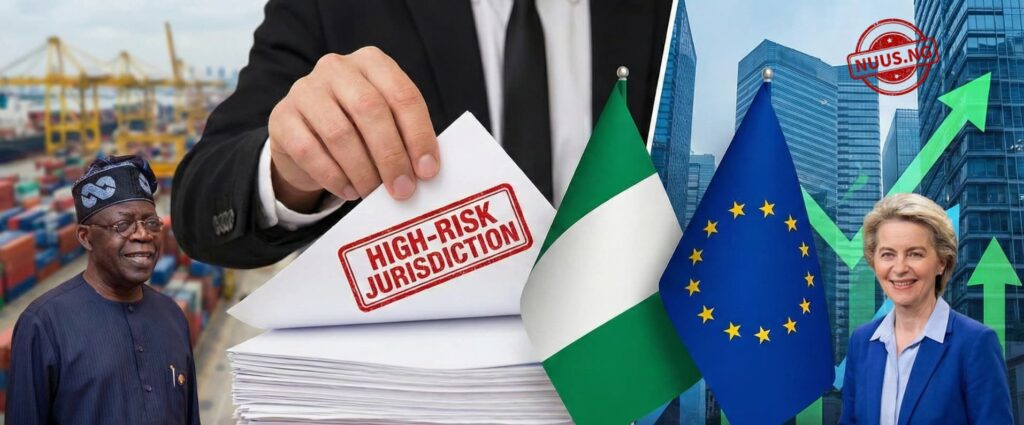
BRUSSELS — The European Union has officially removed Nigeria from its list of “high-risk third-country jurisdictions,” a major diplomatic and economic victory that is expected to significantly ease the cost of doing business between Nigeria and Europe.
The decision, which follows Nigeria’s exit from the global “grey list” late last year, means that Nigerian businesses and travelers will no longer face automatic “enhanced due diligence” checks when transacting with European banks.
Quick Read
- The News: The European Commission has deleted Nigeria from its list of high-risk countries for money laundering and terrorism financing.
- Effective Date: The new regulation takes effect on January 29, 2026, lifting strict financial checks on Nigerian transactions.
- Why It Happened: The EU cited Nigeria’s successful reforms and its earlier removal from the Financial Action Task Force (FATF) “grey list” in October 2025.
- The Impact: This move will reduce transaction processing times, lower compliance costs for Nigerian banks, and boost foreign investor confidence.
- Govt Reaction: The Minister of State for Finance, Dr. Doris Uzoka-Anite, described the development as a “big win” that validates President Tinubu’s financial reforms.
Detailed Story: A Clean Bill of Health
ABUJA — After years of rigorous financial scrutiny, Nigeria has finally cleared its name in the European financial system. The European Union (EU) confirmed on Thursday that Nigeria, alongside South Africa and four other African nations, has been removed from its high-risk list.
This listing had previously categorized Nigeria as a country with “strategic deficiencies” in its Anti-Money Laundering (AML) and Counter-Terrorism Financing (CFT) regimes, forcing EU banks to treat every transaction coming from Nigeria with extreme caution.
End of “Enhanced Due Diligence”
For years, Nigerian businesses attempting to pay suppliers in Europe or Diaspora Nigerians sending money home faced delays and extra paperwork. This was due to Article 9 of the EU’s Anti-Money Laundering Directive, which mandated “enhanced due diligence” for any fund flow involving high-risk countries.
Starting January 29, 2026, these mandatory extra checks will be scrapped.
“This decision represents an important external validation of Nigeria’s steady progress,” said Hafsat Abubakar Bakari, CEO of the Nigerian Financial Intelligence Unit (NFIU). “It demonstrates that consistent reforms… can translate into tangible international outcomes.”
The Path to Delisting
The journey to this “clean bill of health” began in earnest in October 2025, when the global financial watchdog, the Financial Action Task Force (FATF), removed Nigeria from its grey list.
The Nigerian government had to implement a tough 19-point action plan, which included:
- Strengthening the legal framework against money laundering.
- improving the investigation of terrorism financing.
- Enhancing the transparency of beneficial ownership (knowing who really owns a company).
What This Means for the Economy
Financial analysts predict immediate benefits for the Naira and foreign investment.
- Cheaper Transactions: European banks will no longer need to spend as much money “vetting” Nigerian transfers, which could lower fees.
- Correspondent Banking: Nigerian banks can now re-establish relationships with top-tier European banks that previously “de-risked” and left the Nigerian market.
- Investor Confidence: Being off the high-risk list is a “green light” for institutional investors who are legally barred from investing in high-risk jurisdictions.
Minister of Finance, Wale Edun, noted that the milestone was only possible due to “extraordinary leadership” and urged stakeholders to sustain the reforms to ensure Nigeria never returns to the blacklist.