
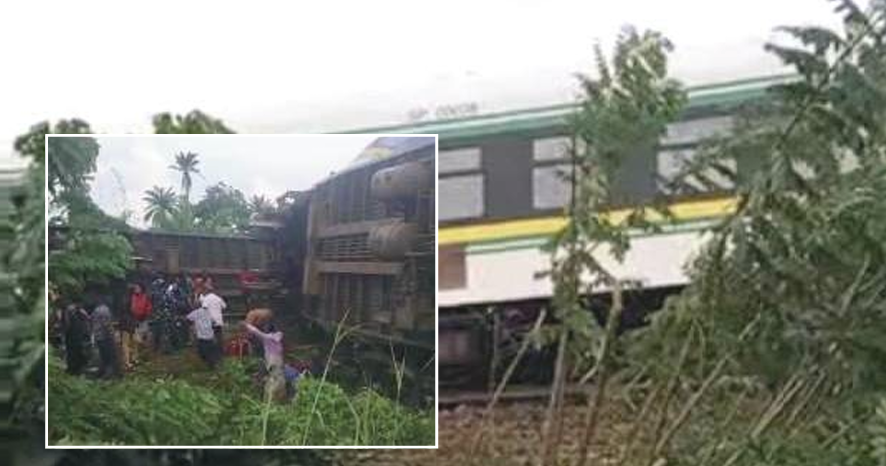
Agbor’s Blood On The Tracks: Ujevwu-Itakpe derailment exposes systemic collapse of rail network
•4 dead, 35 injured in Monday’s crash
•Reps recycle Senate call for Executive action, urge compensation for casualties
By Egufe Yafugborhi & Ochuko Akuopha
It’s the bill for obsolete architecture and negligent management coming due and bleaching out public confidence as a rail transportation to ease movement of men and goods now moves grief.
The wail of sirens at Agbor, Ika South Local Government Area (LGA), Delta state fateful 8 June 2026, did not signal just another train mishap. It announced a reckoning.
Four passengers confirmed dead, 35 others counting their breaths across three Delta hospitals: 13 at Central Hospital Agbor, 12 at General Hospital Owa-Oyibu, 10 at General Hospital Owa-Alero.
The train was Ujevwe Station bound, from Itakpe takeoff. Four coaches, sliding off the ballast along the Agbor forest corridor capsized, another derailed, rolling into thick vegetation and trapping commuters in mangled steel. Ugly.
Nigerian Railway Corporation (NRC) first confirmed three fatalities as “relevant authorities continue to assess the full circumstances”. NRC Manging Director, Kayode Opeifa announced, “Emergency Forensic Audit” and shut down operations.
Permanent Secretary, Ministry of Transportation, Mr. Funsho Adebiyi, updated that the dead comprised two women, one man and an infant.
Onboard the trip were 482 persons, including 442 booked passengers and 40 others involving crew, security personnel and third-party service providers.
Twenty four passengers sustained serious injuries, several others suffered varying degrees of injuries and receiving treatment.
Adebiyi had stated, “Notable individuals on board include Ede Dafinone (Senator Representing Delta Central District) and a former Secretary to the Delta State Government, Mr. Patrick Ukah.”
NRC’s MD, Dr. Kayode Opeifa, later dismissed that claim. “Contrary to an earlier statement, Senator Dafinone, and former Secretary to the Delta State Government, Hon Ukah, were not passengers onboard the Warri–Itakpe Train Service involved in the accident near Agbor.
“Both distinguished individuals rather, greatly assisted in the mobilisation of first responders and other emergency personnel who participated in the rescue operations following the incident”, Opeifa clarified.
The injured include an NRC staff who reportedly suffered a traumatic limb injury but in stable condition.
Rescue
Delta Governor, Sheriff Oborevwori, measuring it as “heartbreaking and unfortunate”, dispatched commissioners and local council chairs to lead rescue.
Aside the applauded Delta government’s efforts, Adebiyi’s roll call on others deserving credit on the rescue and evacuation operations include the National Emergency Management Agency, Federal Road Safety Corps, the Nigeria Police Force, Nigeria Security and Civil Defence Corps, local authorities and volunteers.
Regardless of the huge toll, calling this an “accident” is to lie by omission. The national rail line, Agbor corridor not an exception, is a crime scene, the crime, systemic neglect.
A Pattern, Not An Isolated Case
This is not the first time Agbor has swallowed steel and lives. It is the latest chapter in a timeline that reads like a lingering warning ignored.
In the timeline on Ujevwu-Itakpe axis of failure, July 2024, several coaches derailed near Ujevwu, Delta State. No injuries reported, but NRC suspended service for two days. The first tremor.
February 2025 – Train service halted over technical fault. Resumed Feb 22, only to break down again. Passengers begin petitioning lawmakers over “incessant breakdown… derailing, fire outbreak… cancellations whilst passengers are at stations.”
April 10, 2025 – NRC suspends operations 72 hours after multiple engine failures. Faults addressed, but suspension extended for “safety system upgrades”. 7404
July 15-19, 2025 – Service abruptly cancelled July 15. By July 19, the train “collapsed along its way to Itakpe,” stranding passengers overnight in the “Forest of Ajaokuta”. No rescue for two days.
Oct 29, 2025 – NRC resumes Warri-Itakpe service after suspension since Aug 2 for “technical faults”.
Nov 1, 2025, 7:30pm – Two of seven coaches derail at Km 212+8m, Agbor. NRC blamed “suspected track vandalism” – four fish plates and flat iron pieces removed. No casualties then. Service suspended indefinitely for “comprehensive security and safety audit”
Nov 2025 – Senate probes rail system after Ede Dafinone’s motion. Lawmaker notes the line, barely four days after resumption, suffered “maintenance downtime on a Thursday, major mechanical fault Friday, derailment Saturday Nov 1”.
Senate warns of “grave safety lapses, inadequate technical supervision, and poor maintenance culture”.
May 2026 – NRC temporarily suspends Warri-Itakpe again for “operational exigencies and technical recommendations from its engineers” to enable “critical operational assessments”.
June 8, 2026 – The architecture fails again in another derailment. Four coaches leave the track at Agbor. Four dead, 35 wounded.
‘Obsolete, Negligent’ Equals ‘Fatal’
The 326km Warri–Itakpe standard-gauge line was meant to link South-South to North-Central, move passengers, goods, and industrial materials. Now it moves grief.
NRC itself admits the line was “put on hold two months ago” for safety, with “almost every kilometre” of track, clips, bolts replaced. Yet vandals still removed fish plates “not unique to this side but to many other sides in the bushes”.
Guards exist, “a guard train watches over what is going on behind” and “men working daily on these tracks”. If the architecture and surveillance cannot hold, the management must.
Between 2020-2025, National Bureau of Statistics recorded over 188 rail-related incidents, many linked to vandalism. Vandalism a factor, but obsolete signalling, patchwork maintenance, and suspension-resumption cycles without structural overhaul are the conditions that let vandalism translates to mass casualty.
Senator Dafinone, whose motion forced a Senate probe, said the line’s “deterioration and repeated service interruptions have caused hardship for commuters and disrupted supply chains vital to the nation’s economy”. He asked for “full rehabilitation and stronger safety measures”.
Monday’s victims did not die from vandalism alone. They died from a system that treats “technical recommendations” as a pause button, not a rebuild. From architecture built for yesterday’s load, managed with today’s shortcuts.
Survivors’ Testimonies
Gospel musician, U.D. Okon was travelling Itakpe, Kogi ’! Warri on the Ujevwu bound trip.
He narrated, “I traveled in this train from itakpe in kogi state to warri. It was the most horrible experience of my life. While am grateful to God that I am alive and well, sadly same cannot be said of some who died, others badly injured, permanently disfigured.
I am deeply saddened for a mother who died and left behind two young kids, a young child whose head was cut off and many other gory experiences.”
Jane Ogunyon, a femail survivor said, “Roads are not no good. The train became our saving grace to travel and move good for its affordability and sense of safety.
“When the train service was introduced, it was like this. These days, the train is not good at all. Before the crash the train had started shaking. A couple of minutes after, the derailment happened.”
Mauwa Mohammed’s had a more pathetic experience. Her 28 year old daughter didn’t survive the mishap, leaving her two children with her mother unhurt.
“Now I’ve lost my daughter. My husband and son-in-law are coming to pick us the children. It’s painful. The train has become really bad.”
Reps Recycles Senate’s Earlier Concerns
On the floor of the House of Representstive, a day after the tragedy, Member Representing Ughelli North, Ughelli South and Udu Federal Constituency, Rev Francis Waive, moved for probity over the incident.
Waive’s motion, Overwhelmingly supported and referred to the Committee on Land Transport for further legislative action, recycled concerns earlier raised by Dafinone in the Senate and fallen to the Executive’s deaf ears.
He stressed the imperative to ascertain the failures, emplace measures to guard repeat of the mishaps, and instead guarantee “passenger safety, operational integrity, maintenance standards, and emergency preparedness on the nation’s railway system.”
It was sheer reminder on Natinal Assembly’s lack of will to bite when its recommendations in calls for action are blatantly ignored by the implementing Executive arm of government.
Waive, moved further on this one. “Beyond the loss of lives and injuries sustained, many travelers on board suffered significant financial losses, emotional trauma, disruption of scheduled engagements, and damage to personal belongings arising from the accident.
“The House recommends that government adequately compensate all passengers on the affected trip for losses incurred, injuries sustained, trauma suffered and inconveniences occasioned by the accident.”
No Romancing The Failure From Onset
For blunt Zik Gbemre, Coordinator, Niger Delta Peace Coalition, “Don’t blame it all on poor maintenance and slack management. Much of the rail network architecture were failed at installation.
“The system emplaced by the Buhari administration through Rotimi Amaechi as Transport Minister were only efficient in the media. Obosolete coaches, some without new replacement parts garbaged in from China cannot give the nation a reliable rail transportation.
“Waive is worried travelers may lose confidence. They already do, particularly on the Ujevwu-Itakpe line. When it opened, it instant leisures for many families who would just take the pleasure ride to and fro Ujevwu-Itakpe.
“Before long, passenger safety and operational integrity disappeared. Unforseen operational disruptions from frequent equipment breakdown and vandalism on the tracks became order of the day.
“One week in operations, the next three the network inoperative. Travel schedules no more reliable. Disenchantment is growing. Let’s not deceive ourselves. We need modern rail architechure, not expired China machinery.”
Underlining Question
As recovery crews prepare to lift the wreckage Tuesday, the question for Abuja is not just who removed the fish plates. The concern is not about those in position to allocate values standing for a minute silence for the dead.
The basic question is why, after Nov 2025’s derailment, after Senate warnings, after May’s suspension for “safety assessments,” the Agbor corridor was allowed to load hundreds of passengers again on same tired rails. The answer, for now, is on the tracks, four body count afterwards.
The post Agbor’s Blood On The Tracks: Ujevwu-Itakpe derailment exposes systemic collapse of rail network appeared first on Vanguard News.