
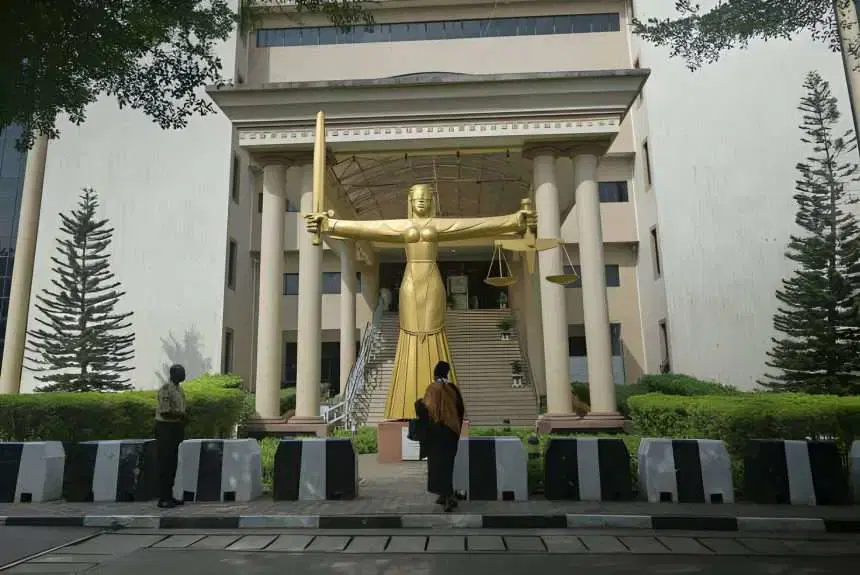
2027 Polls: FHC approves filing of cases on weekends, public holidays
By Ikechukwu Nnochiri
As courts grapple with a surge of pre-election litigation, the Federal High Court’s new Practice Direction now allows litigants to file processes on weekends and public holidays.
The Chief Judge, Justice John Tsoho, who repealed the 2022 version of the Practice Directions, directed the Registry of the Court in all Judicial Divisions to henceforth open on Saturdays, Sundays, and public holidays, between 10 a.m. and 2 p.m., exclusively for the filing of pre-election cases.
The new directive came barely 24 hours after the Chief Justice of Nigeria (CJN), Justice Kudirat Kekere-Ekun, decried the increasing delays in the adjudication of cases.
Speaking at the opening of the National Workshop on Case Management for Judges of the Superior Courts of Record, organised by the National Judicial Institute in Abuja, the CJN urged the adoption of proactive measures to tackle delays in the administration of justice and bolster public confidence in the judiciary.
She maintained that the judiciary’s effectiveness is measured not only by the quality of its judgments but also by the speed and efficiency with which cases are received and resolved.
Prior to the 2023 general elections, Justice Tsoho had constituted special panels to dispose of the many cases plaguing the court’s dockets. He had decried the fact that some judges had over 1,000 pending cases in their files, noting that the situation was particularly worse in the Abuja, Lagos, and Port Harcourt divisions of the Court.
According to the CJ, Sections 29(5) and 84(14) of the Electoral Act, 2022, vest in the High Court exclusive jurisdiction to hear and determine pre-election complaints, with Section 285(10) of the 1999 Constitution, as amended, mandating that such cases be concluded within 180 days of the date of filing of the suit.
“This is notwithstanding the judges’ existing high-volume dockets, which present enormous challenges. It is necessary to place on record that the Electoral (Amendment) Act, 2022, was enacted without any consultation with the Court.
Also, no support whatsoever was provided to address the increased responsibility. This weighed heavily on the operations of the Court,” he stated during a special session the High Court held to mark its 2022/2023 legal year.
The avalanche of cases awaiting adjudication in various courts across the country also led the Body of Senior Advocates of Nigeria (BoSAN) to demand the establishment of a National Constitutional Court to be saddled with the responsibility of determining all election-related cases. The legal body bemoaned the fact that many matters, including fundamental rights enforcement suits, have continued to suffer adjournments owing to political cases flooding the High Court.
Meanwhile, the new Federal High Court Pre-Election Practice Directions, which came into effect on June 29, are intended to enhance the speedy, efficient, and fair determination of pre-election matters, in line with the 1999 Constitution, as amended, the Electoral Act, 2026, and other applicable laws.
Justice Tsoho issued the directions in exercise of the powers conferred on him as the High Court’s CJ by virtue of Sections 254, 285(9), (10), and (14) of the 1999 Constitution, as amended, as well as Sections 29(5) and 88(2) of the Electoral Act, 2026.
“The purpose of these Practice Directions is to: (a) provide for a fair, impartial, and expeditious determination of pre-election cases; (b) ensure that, in all election matters, the parties focus on matters which are genuinely in issue; (c) minimise the time spent dealing with interlocutory matters; (d) ensure that the possibility of an amicable settlement is explored before the parties proceed to hearing; (e) minimise undue adjournments and delays in the conduct of matters.”
It stipulated that the Court, in every pre-election matter before it, shall pay particular attention to the provisions of Sections 29(5), (6), (7), 83(5) and (6), 88(1–4) of the Electoral Act, 2026, and Section 285(14)(c) of the 1999 Constitution (as amended).
Likewise, it made it mandatory that anyone challenging the conduct or outcome of a primary election join, as respondents in the suit, all relevant parties, to enable the court to effectively determine the dispute.
On the filing of processes, it provided that every pre-election matter shall be commenced by an Originating Summons, as specified in Forms 3, 4, and 5 of Appendix 6 to the Federal High Court (Civil Procedure) Rules, with such variations as circumstances may require.
“Provided, however, that where a party alleges fraud, forgery, or highly contentious facts in a pre-election matter, the parties shall, in addition to or in lieu of affidavits, set out the particulars of such alleged facts, which shall be examined by way of calling witnesses viva voce or receiving documents in evidence.
“The parties and the Court shall be entitled to summon any person to attend, to produce documents before it, or to be examined or cross-examined before it, in like manner, at the hearing of the suit.
“An Originating Summons shall be accompanied by: (a) an affidavit setting out the facts relied upon; (b) copies of exhibits to be relied upon; (c) a written address; and (d) an affidavit of non-multiplicity of action on the same subject matter.
“A respondent served with an Originating Summons shall, within seven (7) days from the date of service of the Originating Summons on him, file the original and a copy of a duly completed and signed Memorandum of Appearance, as specified in Form 11, Appendix 6 of the Federal High Court (Civil Procedure) Rules, with such modifications or variations as the circumstances may require.
“A respondent served with an Originating Summons shall, within ten (10) days of service, file in the Registry of this Court a counter-affidavit and written address, which may include any preliminary objection raised to the action.
“An applicant on whom a respondent serves a defence shall, if the need arises, serve a reply on that respondent within three (3) days of such service.
“The written address shall be concise, typed in double spacing with a font size of twelve (12), numbered consecutively, and shall not exceed fifteen (15) pages.
“Any amendment to the Originating Summons may be made with the leave of the Court within seven (7) days of service of the respondent’s reply.”
On service of process, the Practice Directions stipulated that a party shall not serve a notice of an application on another party on the date scheduled for hearing.
“To ensure speedy dispensation of justice, electronic mail and other electronic means may be employed by the Court to inform counsel of urgent court and case events, provided that such notification is given at least forty-eight (48) hours before the scheduled court date.
“In line with the provisions of Paragraph 8(2) of these Practice Directions, parties are expected to furnish the Court Registrar with functional telephone numbers and email addresses for themselves and their counsel.
“An application for substituted service shall be made as provided for in the Rules of this Court.”
The new legal instrument vested the CJ with the power to nominate judges to sit in any judicial division for the hearing and determination of pre-election matters, and/or to transfer pre-election matters from one judicial division to another. It also gave any judge handling a pre-election matter the power to leverage technology in the conduct of proceedings, including virtual hearings.
“Upon the close of the exchange of processes between the parties, the Court shall, within seven (7) days, set the matter down for hearing.
“The Court shall continue to accord priority to all pre-election matters until judgment is delivered.
“Where a matter comes up for hearing under these Practice Directions and either party is absent, the Court shall, either suo motu or upon oral application by counsel for the party present, order that the address of the absent party be deemed adopted, if satisfied that the parties had notice of the proceedings.
“The Court and the parties shall prevent unnecessary delays, and accordingly, not more than two (2) adjournments shall be granted to any party to an action covered by the provisions of these Practice Directions. Provided that no application for adjournment shall be entertained on a day fixed for hearing.
“Where a party seeks to change counsel during the lifespan of a case, not more than two (2) adjournments shall be granted to him to do so.
“Where it is expedient, and in furtherance of the objectives of these Practice Directions, the Court may schedule the time and date of hearing on such day and at such time as may be convenient for the parties.
“Counsel shall ensure that they are present in court and ready to proceed with their case at all times.
“Where the provisions of sub-paragraphs (6) and (7) of these Practice Directions become impracticable to apply by reason of ill health or any other unavoidable circumstance, such counsel shall ensure that counsel with the requisite knowledge of the issues before the Court is present and ready to proceed with the case in his or her stead, or shall apply for the case to be heard virtually where practicable, with the consent of the parties.”
On the issue of interlocutory applications, the Practice Directions stipulated that motions for such orders shall, except where the context otherwise dictates, be on notice, stating the rule under which they are brought and the grounds for the reliefs sought, and shall be supported by an affidavit and a written address.
“The respondent(s), upon being served with the processes, shall have five (5) days within which to file processes in response (if any) to the motion on notice, and the applicant shall have three (3) days to file a reply (if any) to the processes of the respondent(s).
“Pursuant to the provisions of Section 285(8) of the Constitution of the Federal Republic of Nigeria, 1999 (as amended), ruling on preliminary objections and other interlocutory issues touching on the jurisdiction of the Court shall be suspended and delivered at the stage of final judgment; provided that, where the objection relates to service of originating processes, the Court shall satisfy itself that the parties have been properly served before proceeding to determine the substantive suit.
“Every application for extension of time shall be made by a motion on notice and shall be supported by an affidavit setting forth good, substantial, cogent, and verifiable reasons for the failure to file within the prescribed period, before time can be extended.”
Even though the directions have already come into effect, they will not be applied retroactively to cases already pending in court.
“In any other case where a cause or matter is pending, the Court shall give such directions as may be necessary or expedient to ensure conformity with the requirements of these Practice Directions,” it stated.
Expectations are high that the new directives will help judges resolve pre-election disputes swiftly as the nation draws closer to its next general election.
The post 2027 Polls: FHC approves filing of cases on weekends, public holidays appeared first on Vanguard News.